NeoDB ATProto Implementation
NeoDB can publish a user's marks, reviews and articles (with ratings embedded) to their ATProto Personal Data Server (PDS) as structured records, in addition to crossposting a human-readable skeet to Bluesky. This lets other ATProto applications read a user's NeoDB activity directly from their repository.
The activity lexicon is project-owned under the net.neodb.* namespace
(reverse of neodb.net), so it is shared by every NeoDB instance. The schema
files live in docs/lexicons/net/neodb/. Long-form
pieces are also published under the standard.site
lexicon; see Long-form documents.
How it connects
How NeoDB reaches the Atmosphere, alongside its ActivityPub federation:
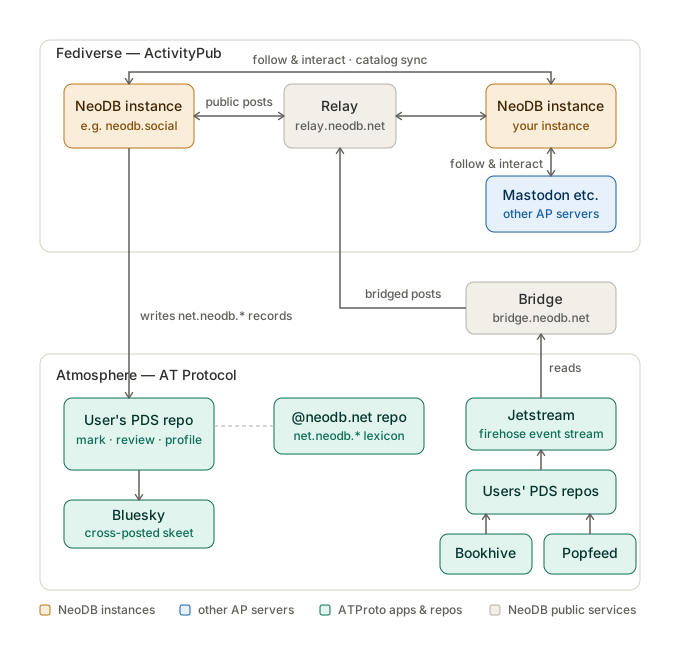
Authentication
Users link their ATProto identity via OAuth
(mastodon/models/bluesky_oauth.py): the login form takes only a handle, which
is resolved handle -> DID -> PDS -> authorization server; the authorization
request is pushed via PAR with PKCE and the user is redirected to their server
to approve the atproto transition:generic scope. NeoDB acts as a confidential
client: the client metadata document is served at
/account/bluesky/client-metadata.json (its URL is the client_id) and token
requests carry a private_key_jwt assertion signed with an auto-generated
ES256 key persisted in SiteConfig. Access tokens are DPoP-bound; a custom
transport for the atproto SDK client signs every XRPC call and transparently
handles server nonce rotation and token refresh. Tokens, the per-session DPoP
key and nonces are stored encrypted on the account. Accounts created before
the OAuth flow keep working through their stored app-password session until
they re-authorize.
Record types
| Collection (NSID) | Written from | Purpose |
|---|---|---|
net.neodb.mark |
a shelf entry | status (+ optional rating/comment/tags) |
net.neodb.review |
a review | long-form review (+ optional rating) |
net.neodb.profile |
the linked account | verifiable link to the NeoDB identity |
site.standard.document |
a review or article | the long-form piece, for generic readers |
site.standard.publication |
the linked account | the owner's journal the documents belong to |
Subject
NeoDB catalog items are not themselves ATProto records, so a work cannot be
referenced with a com.atproto.repo.strongRef. Instead every record embeds a
net.neodb.defs#subject describing the work inline:
{
  "uri": "https://neodb.social/tv/season/abc123",
  "category": "tv",
  "type": "TVSeason",
  "title": "Shogun Season 1",
  "cover": "https://neodb.social/m/item/.../cover.jpg",
  "sources": ["https://www.themoviedb.org/tv/12345/season/1"],
  "identifiers": [{ "type": "imdb", "value": "tt2788316" }]
}
uriis the item's permalink on the originating instance.categoryis the broad media category (book,movie,tv,music,game,podcast,performance,people) -- declared as an open set (knownValues) so future categories do not break validation.typeis the specific NeoDB item class (same vocabulary as the NeoDB API schema), so entities that share a category stay distinguishable —TVShow/TVSeason/TVEpisode,Podcast/PodcastEpisode,Performance/PerformanceProduction, plusEdition,Movie,Album,Game.coveris included only when the item has a non-default cover.sourceslists the external source records (IMDB, TMDB, Douban, Goodreads, ...) the work was matched from, referenced by URL, not raw id, for cross-instance matching.identifiersadditionally lists standardized identifiers of the work -- only well-known identifier types (ISBN, CUBN, ASIN, GTIN, ISRC, OCLC, MusicBrainz, RSS, IMDB, Steam, Itch, WikiData, TMDB person) qualify; site-specific ids stay URL-only viasources.
Rating
A rating is a net.neodb.defs#rating object, { "value": 1..10, "max": 10 },
embedded inline in a mark or review. There is deliberately no standalone
rating record: the value would only duplicate what the mark and review
already carry.
Profile
net.neodb.profile (record key self) links the ATProto account to the
owner's NeoDB identity (DID, AP actor id, profile URL, handle), so records
are attributable and the link is verifiable in both directions. It is
modeled on FEP-c390 identity proofs with the direction mirrored: the
record living in the DID's repo proves the DID side (only the DID holder
can write there), while a W3C Data Integrity style proof signed with
the identity's RSA federation key (published in the ActivityPub actor
document at proof.verificationMethod) proves the NeoDB side. The
cryptosuite rsa-pkcs1-sha256-jcs follows the eddsa-jcs-2022 procedure
with RSA; the signed document includes the did so a record cannot be
replayed in another repo. See the lexicon for the exact verification steps.
It is only written while the identity is publicly discoverable, deleted otherwise, and synced on the account refresh path (login and periodic sync) rather than on crossposting; disconnecting the account removes it.
Long-form documents
Reviews and articles are additionally published as
standard.site records: a site.standard.document
carrying the piece (markdown, plaintext and cover image) and a
site.standard.publication describing the owner's journal (name, summary,
avatar and a theme matching the instance's colors).
The document -> publication link
A document's site points at the publication record by AT-URI. Without
that link the pair reads as a stray page rather than a publication:
bsky.app renders the enhanced article card only when it can resolve a
document to its publication.
A document's canonical URL is the publication's url joined with the
document's path. The publication's url is the owner's profile, so
every piece is served beneath it as well:
publication url   https://neodb.social/users/alice
document path                              /article/<uuid>
canonical         https://neodb.social/users/alice/article/<uuid>
These user-scoped URLs render the same page as the canonical
/<type>/<uuid>, which stays the rel=canonical target, and are not
found when the handle does not own the piece. The crossposted skeet's
external embed points at the user-scoped URL, so the embed, the document
and the page all name one URL.
An owner who is not publicly discoverable has no publication record; their
documents stay loose, with site set to the instance URL so the same
path joins to /<type>/<uuid>.
Discovery and verification
The records name web pages, and the pages name the records back:
/users/<handle>/.well-known/site.standard.publicationreturns the publication's AT-URI as plain text, served under the record's ownurl.- Piece pages carry
<link rel="site.standard.document">and<link rel="site.standard.publication">holding the matching AT-URIs.
Crosspost wiring
The skeet's external embed strong-refs both records, publication first.
The document is written before the skeet so the refs exist, then written
again afterwards to add bskyPostRef pointing back at the skeet, which
keeps off-platform comments discoverable. That second write changes the
document's CID, so the CID in the embed goes stale by design: the refs are
resolved by URI, and bsky.app keeps the original snapshot rather than
re-rendering edited records.
Record keys
Every record is keyed by the mark's or review's own uuid, which is deterministic and derivable from the item itself:
at://<did>/net.neodb.mark/<mark-uuid>
at://<did>/net.neodb.review/<review-uuid>
Keying by the mark/review rather than the subject item keeps the AT-URI stable across catalog item merges, and lets distinct items (e.g. multiple reviews of one work) map to distinct records.
The site.standard.* records use TID keys instead, as that lexicon
requires. The key is frozen on first write, so later backdating cannot
orphan the record.
Records are reconciled idempotently against the PDS: each record that should exist is written by key (overwriting in place on edit), and any record that should no longer exist is deleted.
Fediverse back-reference
Bluesky skeet (app.bsky.feed.post) carries an off-lexicon neodbOriginalUrl
field pointing back to the ActivityPub post URL.
When records are published
Records are reconciled on the same path as Bluesky crossposting, so they require a linked Bluesky/ATProto account and are only written for public pieces (PDS records are world-readable). When a piece's visibility leaves public, or the piece is deleted, its records are removed.
Lexicon publication
The schema is published as a com.atproto.lexicon.schema record under
@neodb.net, with a DNS TXT record at _lexicon.neodb.net pointing to its DID,
so the canonical net.neodb.* lexicon is resolvable from the network.